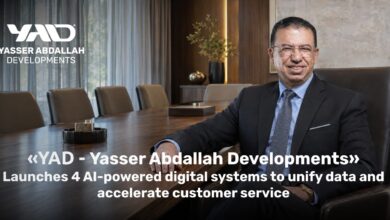


Dr. Ashraf Abdel Mohsen: Artificial Intelligence opens the door to build a national knowledge system to support decision-making in Egypt
Dr Ashraf Abdel Mohsen, Professor of Architecture and Urban Planning at Ain Shams University, said that the rapid development of artificial intelligence technologies opens new horizons for developing methods of thinking, planning, and decision-making, noting that the importance of moving from treating these technologies as tools to accelerate work and increase productivity to employ them in building integrated knowledge systems that contribute to addressing economic, urban, and social challenges, and directly impact the quality of human life.
He emphasized that his vision regarding the application of technology in the field of architecture dates back to 2003, when he presented a scientific concept entitled “Robotized Architecture” at the Seventh International Engineering Conference at Al-Azhar Universit, pointing that this concept explored the possibility of transforming computers into intelligent systems capable of communicating with architects and participating in their thinking and design processes through a robotic assistant that analyzes ideas and drawings and reviews different alternatives to arrive at more advanced solutions.
He added that this vision, which preceded the emergence of generative artificial intelligence applications by about two decades, was not aimed at technological development in itself, but rather at finding ways to employ knowledge and smart tools in designing a better urban environment that meets human material and psychological needs, and preserves nature and resources.
He pointed that this approach led him to initiate a pilot project within “CUBE Consultants” to explore the visibility of building an intelligent knowledge system based on artificial intelligence technologies, as this system would combine engineering knowledge, human experience, and the governing principles of design, planning, and decision-making processes.
He noted that the goal of this project extends beyond simply producing more advanced architectural drawings or accelerating the workflow, but it also aims to assist engineers and management in studying alternatives more comprehensively and assessing the potential impacts of decisions before implementation, based on three key considerations: human quality of life, environmental preservation, and economic viability.
He further explained that the project also includes exploring the potential of leveraging artificial intelligence to enhance organizational management and performance analysis, which involves connecting accumulated knowledge and expertise within the organization, thereby contributing to improve work quality and ensuring the continuity of knowledge across generations, preventing its loss with changes in leadership or the departure of experienced cadres.
Abdel Mohsen assured that this experiment is still in its early stages and faces numerous technical and organizational challenges, however, he added that it represents a practical step in testing the potential of technology to develop institutional thinking and work methods.
He noted that experimentation, research, and learning from the results constitute the fundamental path to reach more mature and applicable solutions.
The professor of architecture and urban planning at Ain Shams University pointed that the successful establishment of a knowledge system within institutions opens the door to consider the application of the idea on a broader scale, which would be achieved by creating a national system that leverages the accumulated expertise of Egyptian scientists, universities, research centers, and institutions, and connects various disciplines and sectors, thus supporting the ability to address national challenges in an integrated manner.
He explained that Egypt is facing economic, social, urban, and environmental challenges, which necessitates moving beyond partial solutions to more comprehensive models based on data analysis and understanding the interrelationships between different sectors, noting that the possibility of employing artificial intelligence in building analytical models for the Egyptian economy, based on real data, studying the country’s resources and capabilities, and benefiting from international experiences, while testing different scenarios and policies before implementation.
He added that evaluating the success of economic policies should not be limited to indicators such as growth, inflation, public debt, and currency exchange rates, rather, it must extend to measure their impact on citizens’ lives through job opportunities, the cost of living, the quality of education and healthcare services, and the equitable distribution of opportunities and services across different regions and generations.
He emphasized that the potential of artificial intelligence can extend to education, health, agriculture, energy, industry, government administration, and urban planning sectors, serving as a tool to assist experts and decision-makers in understanding problems, identifying the connections between their causes, studying alternatives, and assessing their potential effects on society.
He pointed that economic, urban, and social decisions cannot be treated separately, given their interconnected impact on other sectors, as energy decisions, for example, affect industry, housing policies are linked to transportation and employment opportunities, and educational policies influence the future of the economy, which makes the ability to link data, knowledge, and various disciplines one of the most important opportunities offered by artificial intelligence technologies.
Institutional memory: A cornerstone for building national knowledge
He explained that one of the most important benefits of smart technologies is preserving accumulated knowledge and expertise, transforming it into a sustainable institutional memory upon which new generations can build, instead of losing a significant portion due to leadership changes or a lack of documentation and knowledge transfer.
He pointed that building a national knowledge system requires collaboration between universities, research centers, the private sector, and experts through specific scientific and experimental projects based on reliable data and subject to independent evaluation, while adhering to the protection of privacy and the rights of individuals and institutions.
He added that launching such initiatives does not necessarily require establishing a massive system encompassing all sectors of the state, rather, it is possible to begin by addressing a specific real problem, testing the ability of artificial intelligence tools to provide applicable solutions, and then measuring their results and impact on citizens’ lives, paving the way for expanding the scope of the experiment.
He insisted on the necessity of subjecting the results of intelligent models to scientific verification and human review, explaining that artificial intelligence is not an absolute source of truth, nor can it replace human expertise or the responsibility associated with decision-making.
The Age of Robots is reshaping the future of work and urban development
Regarding the future of technology, Abdel Mohsen explained that the world is moving towards a new phase in which artificial intelligence systems are embodied within robots capable of working alongside humans in factories, farms, hospitals, construction sites, institutions, and homes, which may reshape patterns of work, production, and education, leading to the decline of some jobs and the emergence of others.
He added that this development revives his vision of robotic architecture, which he presented in 2003, with the possibility of exploring the embodiment of certain cognitive systems in the form of robots that interact with humans and the working environment, moting that evaluating the success of this technology should not be based solely on the capabilities of the machines themselves, but rather on the actual value they add to human life.
He pointed that the real challenge lies not only in using technology to increase productivity, but also in its ability to alleviate the hardships of work, improve human health, save time, and expand opportunities for learning and creativity, while ensuring that the technological revolution does not become a factor that widens the gap between different segments of society.
Abdel Mohsen assured that human beings must remain the primary focus of all technological, urban, and economic development projects, noting that cities are not built merely to construct buildings, roads, and facilities, but to provide a better life for their inhabitants, similarly, economic development aims not only to improve statistics, but also to provide a dignified life, more equitable opportunities, and a secure future.
He added that the real challenge not in possessing the latest technologies, but in the ability to direct them according to clear human values, assuring that the best future is not necessarily the most technologically advanced, but the most humanitarian, just and sustainable.